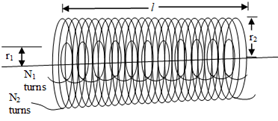
Consider two tightly wound concentric solenoids as shown in Figure. Let l be the length of both the solenoids and let the inner solenoid have N 1 turns and radius r 1 and the outer solenoid have N 2 turns and radius r 2 . Calculate the mutual inductance of M 21 by assuming that all the flux from coil 2 passes through coil 1.
Text Solution
Verified by ExpertsCHECK THE SOLUTION.
Sol. Solenoid is constant in the space within the solenoid and has magnitude
B 1 = μ 0  I 1 = μ 0 n 1 I 1
The magnetic flux through the outer solenoid due to this magnetic field is therefore
 = N 2 B 1 (
  )I 1 = n 1 lB 1 ( π
  ) = μ 0 n 1 n 2 l( π
  )I 1
)I 1
The mutual inductance M 21 is thus
M 21 =  = μ 0 n 2 n 1 l μ
We have calculated the mutual inductance M 21 by assuming that the inner solenoid carries a current I 1 . Note that the area used to calculate the flux through the outer solenoid is not  but
but  the area of inner solenoid. As the magnetic field due to inner solenoid is zero outside it.
If we assume a current I 2 in the outer solenoid, its magnetic field is
B 2 = μ 0  I 2 = μ 0 n 2 I 2
The magnetic flux through the inner solenoid due to this magnetic flux is
 = N 1 B 2 (
  ) = n 1 lB 2 (
  )
)
= μ 0 n 1 n 2 l(  )I 2
)I 2
The mutual inductance M 12 is thus
M 12 =  = μ 0 n 1 n 2 l π
Note that M 12 = M 21 and it is a generalized result; therefore we usually drop the subscripts and write mutual inductance as M.
Prepare Smarter with CGP Edu
Get practice questions, solutions, and test series in one place.
Write a Review
Share your experience with this question and solution.
Commentary
Send your comment, doubt, correction, or feedback to admin.
Similar Questions
Explore conceptually related problems